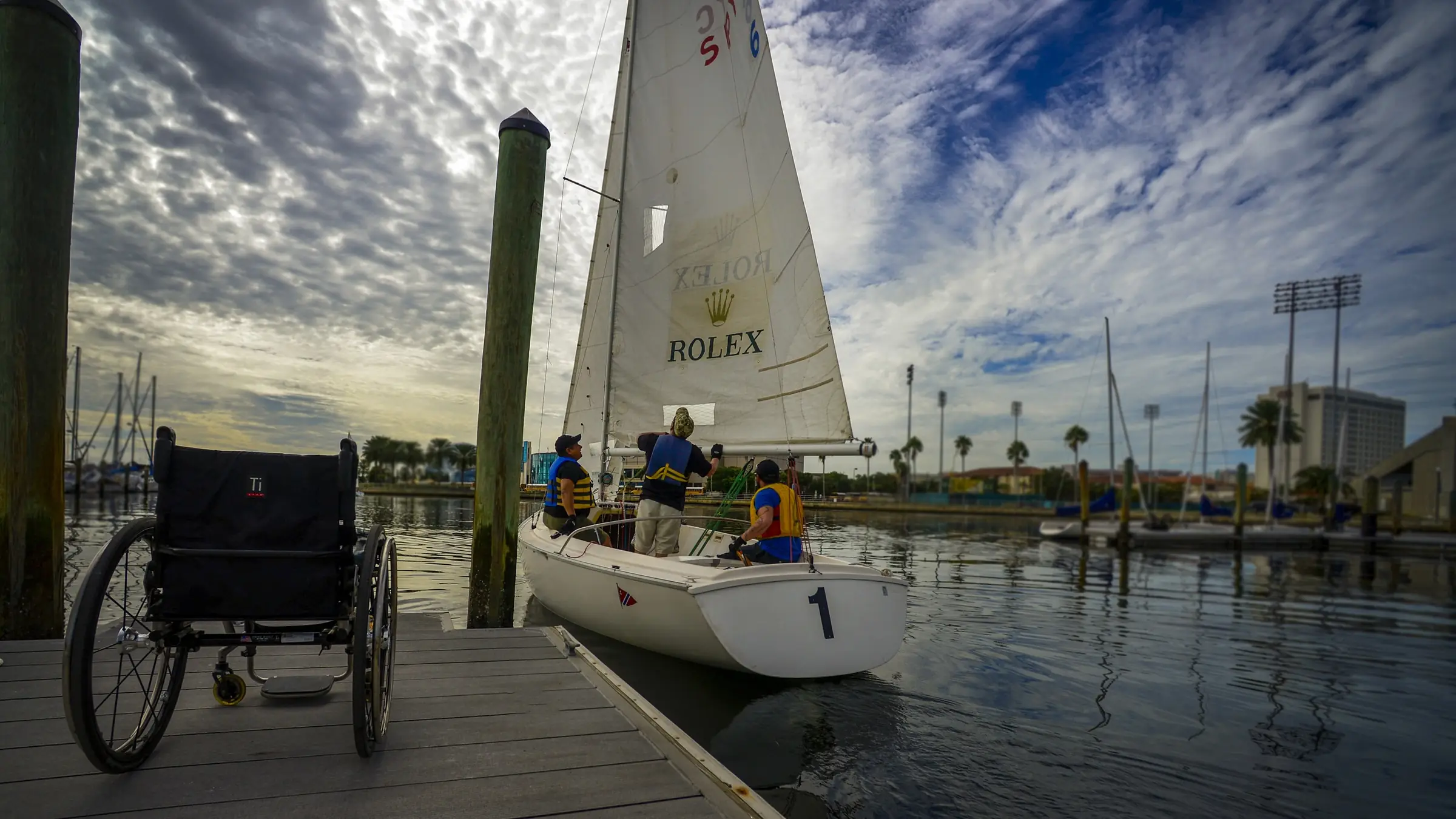
Florida’s adaptive sailing lives at a handful of waterfronts, and most of it costs little or nothing. Two nonprofits on the same Coconut Grove shoreline have been putting wheelchair users, blind sailors and veterans onto Biscayne Bay since 1990 and 2005. The public sailing center in St. Petersburg keeps patient lifts on its floating docks. A county park in Naples, a community sailing center in Vero Beach and a volunteer group on Clearwater’s Sand Key run seasonal sessions in boats built so that nobody has to move once they are aboard. Here is what the boats are, where the accessible sailing is, what each program asks of you, and how the first sail gets arranged.
The boats
Adaptive sailing mostly means two changes to an ordinary boat: a seat the sailor stays in, and controls brought to that seat. A few designs were drawn that way from the start, and Florida’s programs sail a recognisable set.
- Sonar. Bruce Kirby’s 23-foot keelboat of 1980, with 930 pounds of lead in the keel, a cockpit long enough for a coach beside the crew, and class rules that forbid hiking. That combination made it the three-person keelboat of the Paralympic Games through Rio 2016. The St. Petersburg Sailing Center keeps Sonars in its fleet, and Team Paradise’s launch and lifting procedures are written around them.
- Freedom Independence 20. A 20-foot keelboat designed for sailors with disabilities. It was the first boat Shake-A-Leg Miami operated, and the Shake-A-Leg Freedom 20s still race as their own class, disabled and able-bodied competitors together, at the Columbus Day Regatta.
- Hansa 303. A ten-foot dinghy (3.03 metres) for one or two sailors who sit facing forward and steer with a joystick, with low ballast and high sides for stability; servo-assisted drives can be fitted for sailors who cannot work the joystick by hand. World Sailing adopted it for para events in place of the Sonar and the SKUD 18. The Vero Beach program sails them.
- Teaching keelboats with the adaptations added. St. Petersburg teaches on Ideal 18s and says adaptive boats and equipment are available on request. Shake-A-Leg’s ASA fleet, in its own words, is hulls that were “either designed for stability, agility and movement on board, or modified until it was.”
- Beach cats and small sloops. Shake-A-Leg sails Hobie Cats, which it describes as fast and accessible to people with disabilities; Vero Beach sails a Hobie Getaway 16 and a Precision 21 beside the Hansa, and on occasion its Flying Scots.
- Impossible Dream. A 60-foot sailing catamaran built to be operated from a wheelchair, conceived and built by Mike Browne and later acquired and funded by Deborah Mellen. She sails the East Coast each summer and is based at Shake-A-Leg Miami the rest of the year. Sails aboard are donation-funded; the boat’s own site takes enquiries by email.
Getting aboard: accessible docks, lifts and wheelchair transfers
The dock is the part a first-timer worries about, and it is the part these programs have solved. At the St. Petersburg Sailing Center the floating docks are wheelchair-accessible and fitted with Hoyer lifts, the sling hoists hospitals use, to move a sailor from chair to cockpit. At Shake-A-Leg you can roll from the parking lot onto the dock, the campus has lifts, and the whole facility was mapped independently by Wheel The World, the accessibility-verification service, so a wheelchair user can read what the site looks like before driving over. Team Paradise, two doors along the same shore, calls itself wheelchair friendly. The park and foundation programs work from their own boats and life jackets, and the Vero Beach program puts caregivers on a powerboat to watch the sail.
Where the programs are
Coconut Grove, Miami: two nonprofits on one shoreline
Shake-A-Leg Miami is the state’s longest-running adaptive program, founded in 1990 by Harry Horgan in a 1932 seaplane hangar on South Bayshore Drive, and it has the deepest menu. Twenty sailboats and sixty kayaks, with adaptive boats and equipment across the fleet. A Sunday Social runs weekly, year-round and free, open to people with and without disabilities, with sailing, paddling, fishing and island trips on Biscayne Bay. A Family Day Sail, quarterly on weekends, is a free full day on the bay for any family with a member who has a disability, lunch included; you reserve by email and tell them what you need. The organization is a registered American Sailing school and teaches ASA 101 on adapted keelboats, open to anyone 16 and over with or without a disability, over five Saturdays of classroom and water time; instructors work around physical, sensory and cognitive disabilities, a caregiver can come aboard, and scholarships are available. ASA 102, 103 and 104 are listed as coming. Blind sailing is announced and taking names: Shake-A-Leg first sailed with blind and low-vision sailors in the 1990s and hosted the World Blind Sailing Championships in 1999, and the new program will run under ASA-certified instructors with spoken guidance from sighted crew. The fall 2026 ASA cohort was full by October, so ask early.
Team Paradise Sailing, founded in 2005 by the Olympic gold medallist Magnus Liljedahl, is Miami’s US Sailing-accredited community sailing center and sails from the same waterfront. Its SailWell program is therapeutic sailing for neurodiverse sailors, with the boats, skippers, safety boat, life jackets and a snack all provided. Its Veterans and First Responders sessions run Thursdays from 10 to 2 and Sundays from 10 to 1 and are booked online. The boats are adapted to the sailors, and the point, in the center’s own phrase, is that participants help sail rather than ride.
St. Petersburg
The St. Petersburg Sailing Center at Demens Landing is the city’s public sailing hub and describes itself as a fully accessible facility offering sailing to everyone regardless of ability. The adaptive program sits in the adult menu beside the learn-to-sail classes. Adaptive sailors join the center as members to day-sail and race, and the center’s annual sponsored clinics are free and open to the public. Adaptive boats and equipment come on request, and enrolment runs through the center’s booking portal or a phone call. The center is also where Warrior Sailing, covered below, runs its St. Petersburg camps.
Clearwater
Sailability Greater Tampa Bay is a volunteer nonprofit that runs community sails from the Clearwater Community Sailing Center on Sand Key, at 1001 Gulf Boulevard, for adults and children of all abilities, people with special needs in Sailability’s own phrase, in fully accessible boats with an experienced volunteer in each one. Sessions go on a published calendar, registration is required, and new sailors are welcome; the next community sail on the calendar as this guide was written was Saturday November 14, 2026, from 10 to noon. The organization describes its sailing as affordable and runs its own veterans’ sailing events alongside. Details are on sailabilitytampabay.org.
Naples
The Freedom Waters Foundation runs adaptive sailing at Sugden Regional Park in Naples from November through May, three days a week, in partnership with Collier County Parks and Recreation. Children and adults with disabilities are welcome, no sailing experience is needed, the foundation provides the boats and life jackets, and immediate family and caregivers are welcome to come and watch. The cost is nominal, by the foundation’s description, and the season ends with the Murdo Smith Adaptive Sailing Regatta for past participants. Sign up is a participation form on freedomwatersfoundation.org.
Vero Beach and Jensen Beach
YSF Community Sailing in Vero Beach, formerly the Youth Sailing Foundation of Indian River County, runs an adaptive program for sailors with disabilities, free to residents of the county. Sessions run twelve weeks, one starting in September and one in January, and the dates go up on the foundation’s site about a month ahead; the fall 2026 session runs from September 28 to December 15. Sailors book one-hour slots, Mondays from 10 to 2 and Tuesdays from noon to 4, at most four to an hour, and sail with a trained instructor in a Hansa, a Hobie Getaway 16 or a Precision 21, with the Flying Scots out on occasion, whichever suits the sailor and the day. Each sailor can bring up to two caregivers or family members, who watch from a powerboat. The volunteers include retired police chiefs, EMTs, firefighters and rescue swimmers. New sailors start with a six-week summer introduction that includes a life-jacket test, in a pool or at the waterfront, with pontoon-boat rides on days too hot or too calm to sail. Registration is open all year on ysfirc.org, and registered families get an email with the coming dates and open slots. Down the coast in Jensen Beach, the US Sailing Center of Martin County runs Success Sailing, one-to-one coaching that teaches sailing to athletes with intellectual disabilities; the center’s site carries the contact.
For veterans
Veterans have the most options of anyone on this page, and some of them are free.
- Warrior Sailing is the national program of the USMMA Sailing Foundation for wounded, ill and injured service members and veterans of every branch. Its Basic Training Camp is three days of sailing and sailboat racing, with four participants and a coach to a boat, every adaptive and sailing need provided, and no cost to qualified participants: instruction, boats, meals and local transport are covered, and you pay only your travel. Graduates can go on to certification camps toward ASA Basic Keelboat and to racing. Camps fill and run a wait-list, so the application on warriorsailing.org is the first step; the program’s St. Petersburg camps run with the St. Petersburg Sailing Center.
- The Veteran Sailing Association in Tavernier waives its ASA 101 and 103 course fees entirely for active-duty military and honorably discharged veterans. Founded by a Navy SEAL, with an instructor twice named ASA Instructor of the Year, it had taught 375 veterans by its own count.
- Shake-A-Leg Miami gives veterans a reduced rate on ASA 101, with a further reduction for veterans with a disability, and runs a veterans’ adaptive fishing program; Team Paradise runs its veterans and first responders sessions twice a week.
- The Southernmost Sailing School in Key West takes up to four veterans out on a discover-sailing cruise one weekend a month from November through May, and offers them a discount on its courses.
- Many Florida ASA schools discount the 101 course for veterans, active military and reservists through ASA’s Veterans Sailing Education Program. The schools directory has a veterans-program filter.
Arranging a first sail
- Write or call first, and say what you need. Every program on this page asks for it, and the better ones say so in print: Shake-A-Leg tells families to say what they need and promises the staff will plan around it, and its blind-sailing page asks whether you have sailed before and what would help you feel comfortable. Transfers, seating, cognitive support and a companion aboard are all things they have done before.
- Expect a form. Registration runs through an online form at most of them (Shake-A-Leg, Vero Beach, Naples, Warrior Sailing) and a waiver at Team Paradise; Sailability wants you registered before the Saturday.
- Bring a companion if you want one. A caregiver can sail with you in Shake-A-Leg’s ASA course, and family and caregivers are explicitly welcome at Naples and Vero Beach.
- Mind the season. Miami and St. Petersburg sail year-round. Naples runs November to May and Vero Beach in fall and spring sessions, which is the state’s prime sailing season anyway; when to sail Florida has the month-by-month picture, and summer afternoons on any of these bays mean an early start and the thunderstorm line to watch.
- Money is rarely the barrier. Sunday Social, Family Day Sail, the Warrior Sailing camps, Veteran Sailing Association for military, and the Vero Beach program for county residents are free; Naples is nominal; Sailability is affordable by its own description; Shake-A-Leg’s courses carry scholarships. Where a fee exists, the operator’s own page states it.
Racing
Adaptive sailing in Florida has a racing calendar of its own. The Shake-A-Leg Freedom 20 class sails the Columbus Day Regatta on Biscayne Bay each October, with the entry fee waived for the Shake-A-Leg fleet; Warrior Sailing graduates race against disabled and able-bodied sailors nationally; Naples ends its season with the Murdo Smith regatta; and the Hansa 303 is a World Sailing class with its own inclusion championships, so a Vero Beach sailor who takes to it has a ladder to climb.
Last reviewed October 2026.