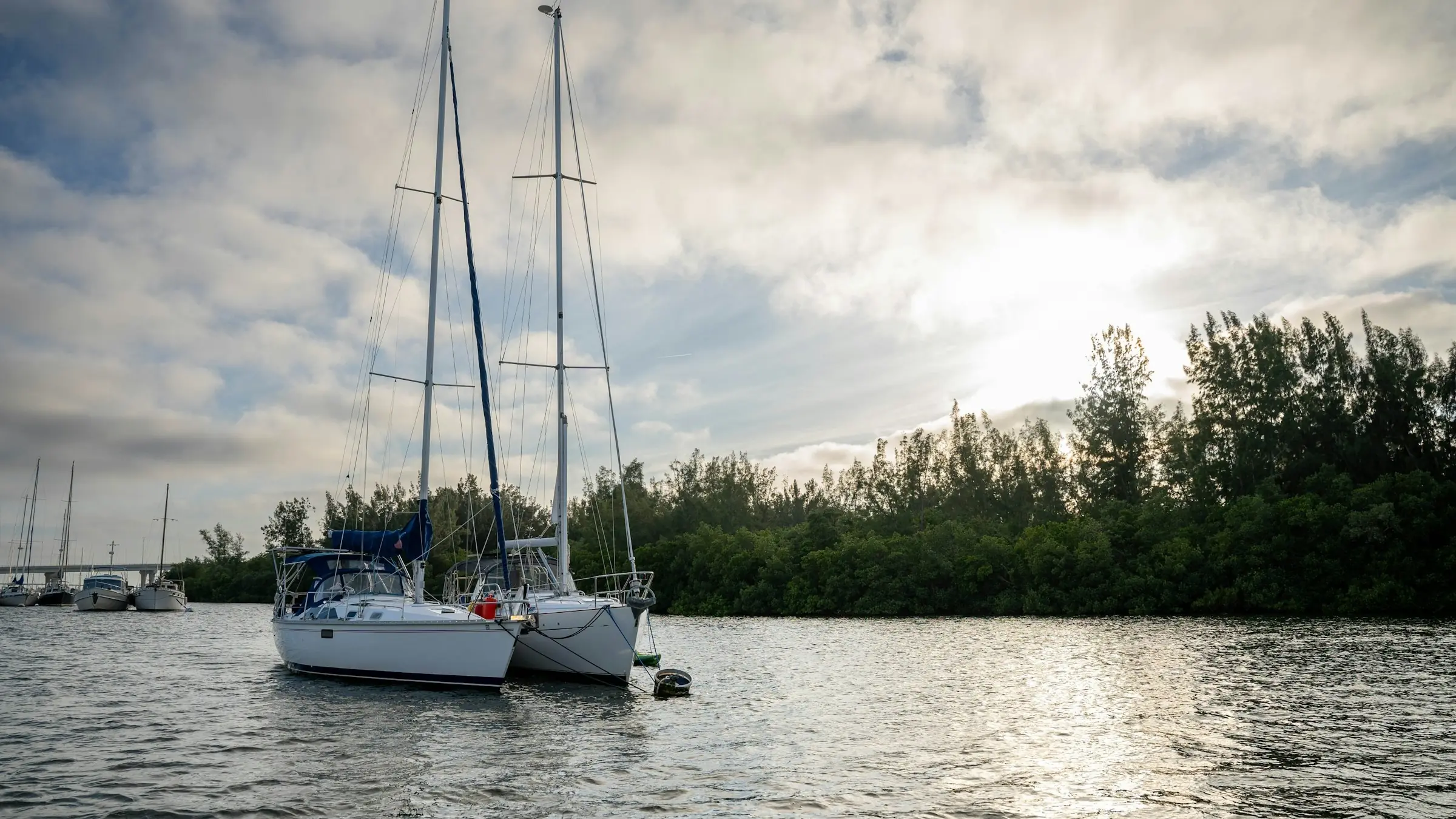
Warm water, year-round sailing, no state income tax, and a coastline full of protected harbors. Florida makes an obvious home for a liveaboard sailor. It’s also more complicated than the postcard suggests. Here’s the starting picture.
Where liveaboards actually keep the boat
There are three basic setups, and most liveaboards move between them:
- Liveaboard marinas. A slip with power, water, pump-out, and a walk to a shower and laundry. The most comfortable and the most expensive, and the number of slips that allow liveaboards is limited; many marinas cap them or have waitlists. Ask specifically; “do you allow liveaboards” is a different question from “do you rent slips.”
- Mooring fields. A city or county maintains a field of moorings you rent by the night or month, usually with a dinghy dock, showers, and pump-out ashore. Cheaper than a slip, more secure than anchoring. Florida’s best-known fields include Boot Key Harbor in Marathon, Vero Beach, and St. Augustine, all popular with cruisers and often full in season.
- Anchoring out. The cheapest and freest option, and the most work: you’re your own water, power, and dinghy service. Great for a while; wearing as a permanent plan.
Know the anchoring rules
Florida actively regulates anchoring, and the rules tightened in 2025 and again in 2026. The statute as it stands in October 2026 has four layers:
- Distances, statewide. No anchoring within 150 feet of a marina, boat ramp or boatyard, within 300 feet of a public mooring field (100 feet until 2025), or within 500 feet of a superyacht repair facility, with exceptions for a breakdown or dangerous weather.
- No-overnight areas. A named list of waters in Miami-Dade and Broward, the cuts between the Venetian Islands and between Palm, Star, Hibiscus and Watson Islands in Biscayne Bay, Sunset Lake, the Sunset Islands and the Middle River in Fort Lauderdale, where anchoring is barred from half an hour after sunset to half an hour before sunrise.
- County anchoring limitation areas. Any county but Monroe may designate one next to an urban waterfront, and in it a boat may stay no more than 45 consecutive days in any six months; the burden is on you to show, with a tracker log or paperwork, that the boat was a mile away inside that window. Counties of 1.5 million people or more can go further and regulate any boat anchored overnight more than 30 days in six months anywhere in their waters, time in a mooring field excluded.
- The Keys. Monroe County is its own case: within 10 nautical miles of a public mooring field or a designated anchoring area, a boat must weigh anchor and move at least half a mile at least once every 90 days, and a liveaboard without a composting head keeps a year of pump-out receipts showing a pump-out in the last 30 days.
Do not assume you can anchor anywhere indefinitely. The text is F.S. 327.4108 and 327.4109; check them, the FWC boating pages and the city ordinance before you settle in somewhere.
Hurricane season is the hard part
June 1 – November 30. A liveaboard’s biggest planning problem isn’t day-to-day weather; it’s what you do with your home when a hurricane is coming. Have a plan before the season: a hurricane hole or hauling contract, a way to strip and secure the boat, and somewhere to sleep ashore. The hurricane guide walks through the whole decision (haul, hole, or slip, and the 72-hour checklist), and the National Hurricane Center is the tab you watch.
The money and the reality
- Costs range from very little (anchored out, solar, no slip) to marina-slip-plus-everything that rivals rent ashore. Insurance, hauls, and boat maintenance are the line items people underestimate.
- Systems matter. Ground tackle, power (solar/lithium), water, and refrigeration are what make full-time aboard livable in the Florida heat.
- Try before you commit. Charter or crew for a few weeks first. A crewed or bareboat charter through the Keys is the cheapest way to find out whether the life fits before you buy the boat.
Where to base
Liveaboard culture is strongest where the cruising is: the Florida Keys (Marathon is a hub), the Treasure Coast around Vero Beach and Stuart, St. Augustine on the First Coast, and the sheltered Gulf coast bays. Each has its own mooring fields, marinas, and personality. Start with the region hubs.
Last reviewed October 2026.