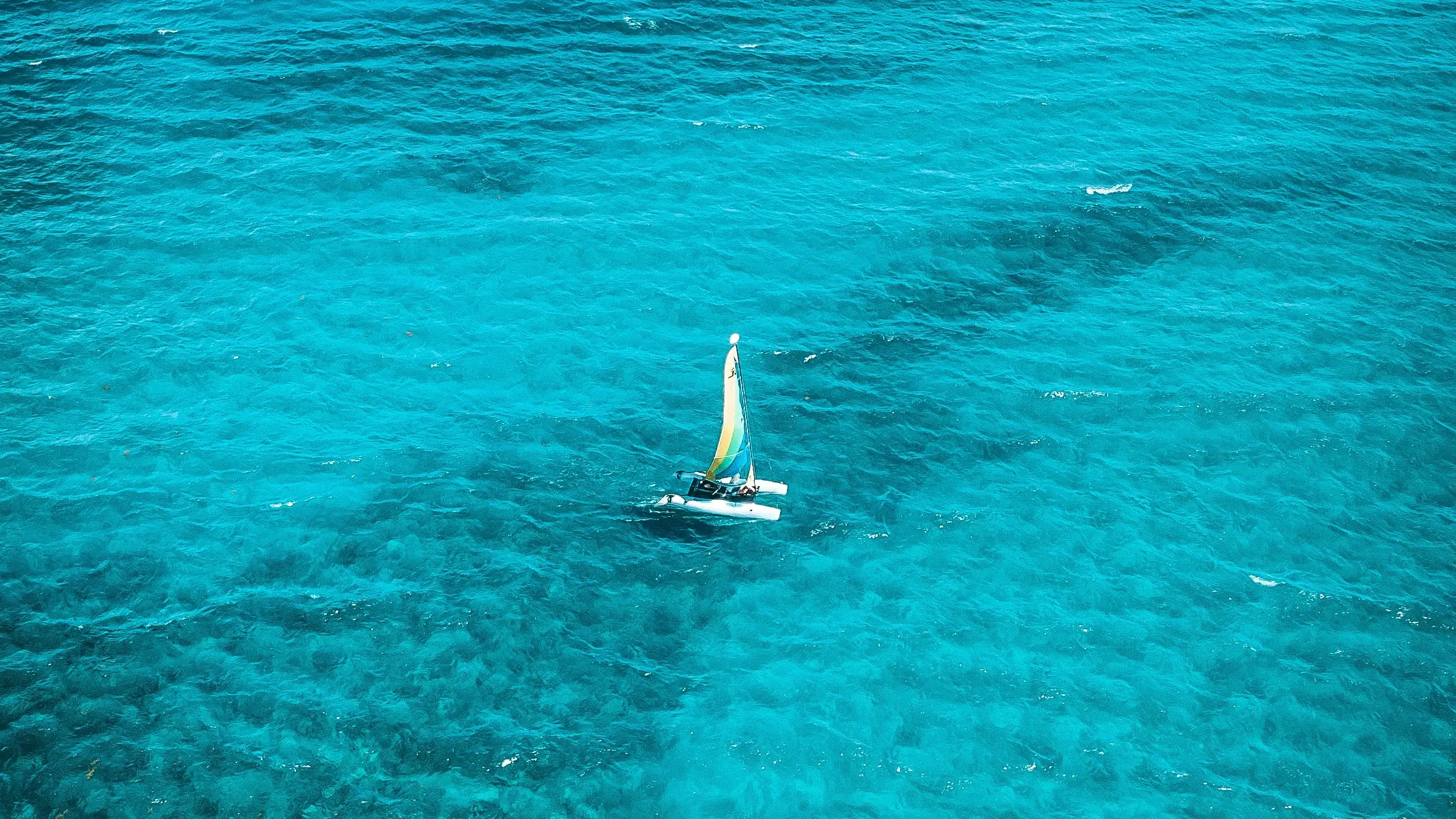
Most of the sailing you can rent in Florida without a certificate, a resume or a reservation lives on a beach. A stand on the sand, a row of Hobies with the sails already up, and a rental by the hour: you show an ID, get a briefing, and someone pushes you off. This is the cheapest and quickest sailing in the state, and it is sold by jet-ski and parasail concessions far more often than by anyone calling itself a charter company, which is why it is hard to find by searching for “sailboat rental”. Here is what the boats are, what the stands ask of you, and where they are.
The boats
Nearly every beach stand in Florida rents from the same short list, so it helps to know the three names.
- Hobie Wave. The beginner boat, and the one you will see most. Thirteen feet, two rotomolded plastic hulls, a single boomless mainsail, and a float at the masthead so a capsize does not turn into a turtle. Carries up to four. Nothing on it can hit you in the head, which is the point.
- Hobie Getaway. The family boat: seventeen feet, a jib as well as a main, wings out over the water to sit on, and room for six. Still simple, with more sail and more speed.
- Hobie 16. The classic, in production since 1969 with over a hundred thousand built, and a different animal: a dual-trapeze racing cat that flies a hull. Only a few Florida stands rent one, and they put it in the “for experienced sailors” column for a reason.
Two other things turn up. Anastasia State Park rents the Aqua Finn, a single-sail dinghy of the Sunfish type, for anyone who would rather sail a small monohull. And a handful of operators rent small keelboats, a Catalina 22 or 30, by the day: a different proposition, covered below.
What “no experience needed” means here
It depends which beach you are standing on, and the stands are candid about it.
At one end, the rental includes the lesson. Coastal Watersports on Anna Maria Island and Scuppers at Baker’s Cay in Key Largo bundle a short lesson for first-timers; PADL at Hobie Beach sells every hour with a briefing and says no prior experience is needed in settled conditions. Delray Beach Water Sports will reacquaint a rusty sailor with the basics and send them off, and will put a captain aboard for anyone who would rather be driven.
At the other end, some stands only rent to people who can already sail. Navarre Beach Ski & Sail requires prior experience and says so up front; Key Sailing on Pensacola Beach is the same; Anastasia Watersports asks for previous sailing experience and a renter over 21. Read the stand’s own rules before you drive over.
Every stand has a wind rule, whether or not it is written down. Navarre publishes its sweet spot as roughly 8 to 15 knots and decides at the beach; Anastasia does not launch over 15 miles an hour and only sails two hours either side of high tide, because Salt Run is a tidal lagoon. A beach cat with no wind is a raft, and a beach cat in too much is a swim, so the phone call before you leave is worth making.
Paperwork, of which there is almost none
Florida’s boater-education card, the one anyone born on or after January 1, 1988 needs to run a motor of 10 horsepower or more, does not apply to a boat with no motor. What a beach stand actually wants is a photo ID, a signed waiver, and sometimes an age minimum for the person on the tiller: PADL sets sixteen for the Wave and eighteen for the Getaway, Anastasia sets twenty-one. Life jackets come with the boat.
Where the boats are
The water matters as much as the stand. Florida’s beach cats sail on three kinds of it.
Protected sound and bay water is where beginners belong. On the Panhandle, Key Sailing at Pensacola Beach and Navarre Beach Ski & Sail at Juana’s Pagodas both launch into Santa Rosa Sound, flat and shallow with the barrier island between you and the Gulf. In Miami, PADL sails Biscayne Bay from Hobie Beach on the Rickenbacker Causeway, the strand named for the boats still rented there. In St. Augustine, Anastasia Watersports works Salt Run inside the state park, a lagoon protected on every side. In Riviera Beach, Get Wet Watersports rents a Hobie 16 and a Wave on the Lake Worth Lagoon. In the Keys, Scuppers puts Hobie Waves onto Florida Bay from the beach at Baker’s Cay, and Sunset Watersports rents Waves and Getaways from two huts on Smathers Beach in Key West, walk-up only.
The open Gulf is the classic Florida beach-cat picture, and in the morning sea breeze it is easy water. Coastal Watersports at Bradenton Beach has rented Hobies off the Gulf for forty years. Holiday Water Sports rents Hobie 14s and 16s from the sand at two Fort Myers Beach resorts, booked online. YOLO Watersports keeps Hobie Waves at the Gulf end of Andy Rosse Lane on Captiva. Panama Beach Service rents Getaways along Panama City Beach from March through October.
The Atlantic has one stand, and it is a different sail. Delray Beach Water Sports rigs a Wave, a Getaway and a Hobie 16 on the sand at Casuarina Road and pushes them straight into the surf. Swell, a real launch, and the only place on this list that will also store your own boat.
The step up: a small keelboat for the day
Between a beach cat and a bareboat charter sits a small group of operators who rent a real sailboat, with a tiller and a cabin, for a day or a weekend, and ask for experience rather than a certificate. Key Lime Sailing Club in Key Largo comes with a cottage and Catalina sloops sailed inside Florida Bay. Latitude Sailing rents one Catalina 30 on Sarasota Bay to sailors over 25 with extensive experience. Florida Keys Sailing at Marathon runs a checkout aboard instead of asking for paperwork. Once the boat gets bigger than that, you are chartering, and the bareboat requirements guide covers what changes.
When to go
Year-round on the beaches, with two caveats. The Panhandle stands thin out in winter: Panama Beach Service closes from November to March and Navarre drops to weekends. And summer afternoons anywhere in Florida bring the thunderstorm line, so the morning rental is the one that goes out; When to sail Florida has the month-by-month picture. Bring water shoes for the launch, cash or quarters where the meters demand it, and the phone number of the stand.
Last reviewed September 2026.