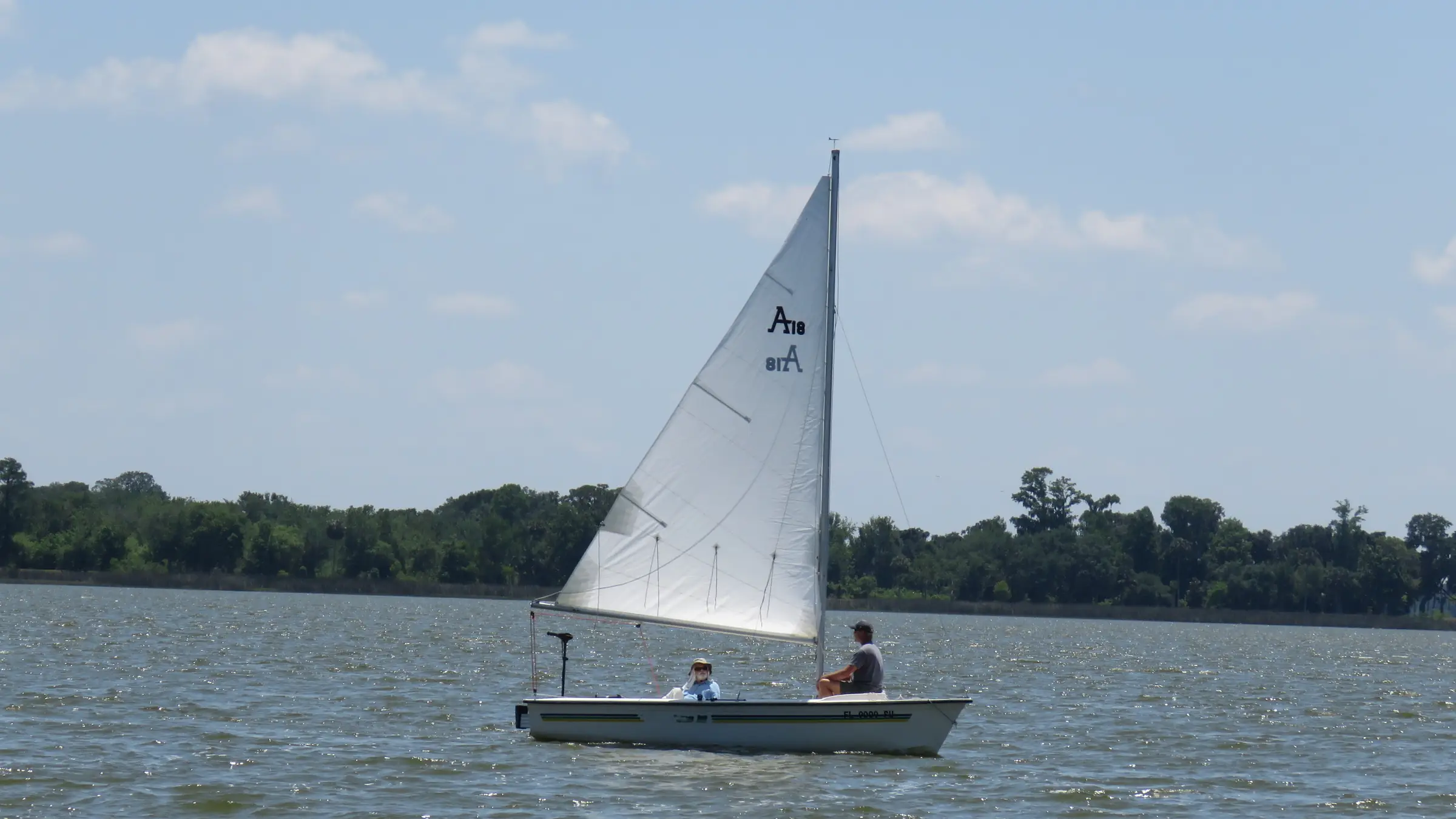
Orlando is the one big Florida city with no salt water, and it has more sailing than the coast gives it credit for. The Harris Chain of Lakes northwest of the city carries sixty-plus days of one-design racing a year, the St. Johns River widens into a lake at Sanford with a club on its shore, and in Winter Park a volunteer club keeps a dinghy fleet on a lake where gas engines are banned. The water is fresh and flat, there is no tide to plan around and nothing to rinse off the trailer, and the wind has habits of its own. Here is where the lakes are, who sails them, when they race, where a trailer boat goes in, and what changes when the nearest inlet is an hour’s drive away.
The lakes
The Harris Chain is the big water. The Florida Fish and Wildlife Conservation Commission counts eight primary lakes in it, Apopka, Harris, Griffin, Eustis, Dora, Beauclair, Carlton and Yale, “totaling about 75,000 acres”, in Lake and Orange counties, and the chain is the headwaters of the Ocklawaha River. Lake Harris is the largest, at more than 13,000 acres. Lake Eustis, about 7,000 acres and spring fed, is joined to Lake Dora by the Dora Canal and to Lake Harris by the Dead River. Everything drains into 9,400-acre Lake Griffin through a dam on Haines Creek and out down the Ocklawaha to the St. Johns; three dams built against flooding have, in the St. Johns River Water Management District’s words, “slowed water flows and stabilized lake levels since the 1960s”. The sailing lakes are Eustis and Dora. Lake Eustis Sailing Club sits on Eustis’s north shore, Mount Dora Yacht Club on Dora’s, and Tavares, between them, calls itself America’s Seaplane City and keeps a seaplane base on Lake Dora beside the public ramps at the west end of its waterfront. Mount Dora’s brick lighthouse, 35 feet tall and dedicated in 1988, marks the city’s harbor, and the chain has over 30 public ramps.
Lake Apopka, at the head of the chain, is the state’s fourth-largest lake and was, in the water district’s own phrase, “Florida’s most polluted large lake” after half a century of farm runoff from its diked north shore. The state bought the farms out from 1996; by the end of 2023 phosphorus was down 69 percent, water clarity up 93 percent, and the submerged plants absent for about fifty years had come back. None of the lake clubs listed here sails from it as of October 2026, and it will be worth watching.
Lake Monroe is the St. Johns River being wide for a while: 9,406 acres, in the FWC’s description “a shallow, wide area of the north-flowing St. Johns River”, with Sanford’s waterfront on its south shore and open lake to the north. The Lake Monroe Sailing Association has its clubhouse on Marina Island at the Downtown Sanford Marina, beside the city ramp. Downstream, near DeLand, the river opens again into Lake Beresford, where Lake Beresford Yacht Club has kept a marina and a cruising calendar up and down the St. Johns since 1944.
Lake Weir is Marion County’s lake, 5,685 acres near Weirsdale, and the home water of the Ocala Sailing Club, which is where the Villages Sailing Club trailers to when the Harris Chain is not on the calendar.
Orlando’s own lakes are smaller and closer. Lake Fairview, spring fed and ten minutes north of downtown, is where Lake Fairview Marina teaches keelboat sailing. Lake Baldwin, on the Winter Park side, is a no-motor lake by city rule: fishing boats with gas engines may be launched, but only electric, sail or manual power may be used on it, which makes it the quietest sailing water in the metro and the home of The Sailing Club. Clermont, to the west, keeps a city ramp on Lake Minneola.
The clubs, lake by lake
- Lake Eustis Sailing Club, Eustis. The racing club of inland Florida, founded in 1953 as a marine club whose sailors took it over by 1982, with more than 60 days of one-design racing a year and active MC Scow, Flying Scot, Wayfarer and Laser fleets. Private and member-owned, with adult and junior instruction through the Lake Eustis Youth Sailing Foundation. The MC Scow fleet’s own page describes a winter destination for snowbirds: an out-of-state sailor can take a regatta membership, store the boat at the club from November to March and sail the club races.
- Mount Dora Yacht Club, Mount Dora. Founded in 1913 on the shore of Lake Dora and, by its own account, Florida’s oldest inland yacht club. Its annual regatta has run since 1954. A clubhouse club: the reciprocity guide has its visiting terms, which include “no dock, moorage, or waterfront access”.
- Lake Monroe Sailing Association, Sanford. Open membership since 1985, a crew finder for people without a boat, Catalina 22, San Juan 21 and Flying Scot fleets, more than half the members’ boats in wet slips at the marina and the rest on trailers. The Wednesday Rum Race runs March to the end of October; Sailfest is the first weekend of December.
- The Sailing Club, Winter Park. All-volunteer, open to anyone who can tack, jibe, recover a man overboard and right a capsize (or who takes the classes first), with a twelve-boat club-owned fleet of Hunter 140s, JY 15s and Hobie Waves at Lake Baldwin Park under an arrangement with the city. Open sailing the first Sunday of the month, racing the second, moonlight sails over on Lake Fairview.
- Villages Sailing Club, The Villages. Residents and registered renters only, founded in 2005 and about 120 strong, trailering member-owned boats to the Harris Chain, Lake Weir and Lake Miona, with charter excursions to St. Augustine and St. Petersburg a few times a year.
- Lake Beresford Yacht Club, DeLand. Chartered in November 1944, a private river club with a working marina and a member cruising calendar on the St. Johns, and no regatta on its books as of September 2026.
- Lake Fairview Marina, Orlando. The city’s ASA school: Basic Keelboat on a Com-Pac 23, fifteen hours over two or three weeks, from a full-service marina on the lake’s east shore.
- Ocala Sailing Club, Lake Weir. Formed in 1976 by a Hobie Cat sailor, Bill Britt, a club whose members’ boats have ranged from 14-foot dinghies to 54-footers and which has, by its own count, the largest number of Boston Whaler Harpoon 5.2s in the country. It has run the Harpoon Nationals since April 2005, sails its Big Sun Regatta every April and its Sunset Harbor Challenge, an around-the-lake race, every October, and its members turn up at Sanford for the Trans-Monroe. Members meet twice a month, and you can join without a boat.
What people sail here
- MC Scow. The boat of Lake Eustis, and the one a coastal sailor will not recognize: a 16-foot scow, flat and blunt-bowed, 420 pounds, a single 135-square-foot sail, and a pair of retractable bilgeboards where a dinghy would have a centerboard. Johnson Boat Works and Melges have built 2,760 of them since 1956 and the class races in over 100 fleets. Eustis is MC Fleet 4, with six to twelve boats on the line for club races and three three-day class regattas a year that draw entries from across the country. A scow wants flat water and heel; the lake supplies the first and the sailor the second.
- Flying Scot. Sandy Douglass’s 1958 design, 19 feet, 850 pounds, 191 square feet of sail, raced by three and able to carry a family, with 5,300 built. The Eustis fleet hosts the George Washington Birthday regatta, the Florida district’s winter fixture since 1972, and Mount Dora’s regatta has a class for it.
- Wayfarer. Ian Proctor’s 1957 cruising dinghy, 15 feet 10 inches, broad enough for three adults, over 11,000 built, and a boat that comes to Eustis from the north each winter for the class’s Midwinters and US Nationals, in January in 2027.
- ILCA (Laser). The single-hander at Eustis, and the teenage step up at the youth programs; the youth sailing guide has the rigs.
- Trailer keelboats. San Juan 21s and Catalina 22s are the Sanford fleets, with Precision 23s, Hunter 23s and an O’Day 19 alongside; San Juan 21 Fleet 29 calls Lake Monroe home. Both classes have a start at Mount Dora, where the 74th regatta in March 2027 invites Optis, ILCAs and 420s for the youth, then Sunfish, Hobie Waves, Flying Scots, San Juan 21s and Catalina 22s, and an open Portsmouth course for everything else. Any class with four boats gets a start.
- Club boats. Hunter 140s, JY 15s and Hobie Waves at Winter Park, a Com-Pac 23 at Lake Fairview, and whatever a Villages member tows.
The season
Lake racing runs on the cool months. Eustis sails numbered club race weekends roughly every other week from September through May, rotating safety-boat duty among the fleets, and fills the gaps with regattas. The dated ones, each on its own page:
- LEYSF Inland Lakes Championship, October 24 to 25, 2026, the youth foundation’s regatta on Lake Eustis.
- Flying Scot Halloween Invitational, October 31 to November 1.
- MC Scow Southeast Regional Championship, November 6 to 8, the opening leg of the class Triple Crown.
- Mother’s Arm Challenge, November 15, a one-day navigation race through the channels and shallows at the east end of Lake Monroe, where a skipper may cut corners if they trust the depth.
- Sailfest, December 5 to 6, Sanford’s first-weekend-of-December regatta for more than 25 years, open to beach cats, planing dinghies and small keelboats.
- MC Trainwreck Regatta, January 22 to 24, 2027.
- Wayfarer Midwinters and US Nationals, January 29 to 31, sailed alongside a Y-Flyer fleet.
- George Washington Birthday Flying Scot Regatta, February 13 to 14, the club’s 57th.
- Lake County Youth Regatta, February 27 to 28.
- MC Scow Women’s National Championship, March 5 to 7, and the Trans Monroe / Southern Challenge at Sanford the same weekend.
- MC Scow Midwinters Championship, March 11 to 13, the regatta that recently put 72 boats on Lake Eustis.
- Mount Dora Regatta, March 20 to 21, the 74th, with check-in the Friday before and registration opening on the club’s site in January.
Then the lake calendar turns over to the weeknights: Sanford’s Wednesday Rum Race from March to the end of October, a 6:25 start once the evenings are long enough, and the Lake Weir club’s Big Sun Regatta and Harpoon Nationals in April. The inland hub and the Central Florida lakes page carry the live rollup, and the events calendar has the whole state.
Ramps and launch points
Most of the boats on these lakes arrive on a trailer, and the public ramps are the sailing infrastructure. The FWC’s own list of shore access on the Harris Chain is the place to start, with its boat ramp finder for the rest:
- Lake Harris. Hickory Point, Lake County’s park at 27341 State Road 19 in Tavares; and in Leesburg, Venetian Gardens at 109 East Dixie Avenue and Ski Beach on Lake Harris Drive.
- Lake Dora. Wooton Park in Tavares, 100 East Ruby Street, where the city’s public ramps sit at the west end of the waterfront near Sinclair Avenue; and Gilbert Park with Palm Island Park in Mount Dora, 411 South Tremain Street.
- Lake Eustis. The Eustis Lake Walk at 601 Northshore Drive is the FWC’s named access; the sailing club keeps its fleets on its own grounds on County Road 452, and its regatta membership lets a visiting boat live there for the winter.
- Lake Beauclair and Lake Apopka. Trimble Park, 5802 Trimble Park Road, Mount Dora; Newton Park, 31 West Garden Avenue, Winter Garden.
- Lake Monroe and the St. Johns. The city ramp beside the Lake Monroe Sailing Association clubhouse at the Downtown Sanford Marina; Seminole County’s Lake Monroe Wayside Park, which the county lists among its ramps; and downstream, Volusia County’s Ed Stone Park at 2990 West State Road 44, DeLand, a free ramp onto the river open around the clock.
- Orlando and Winter Park. Lake Fairview Park, 2200 Lee Road, open 6 a.m. to 11 p.m., with a boardwalk and observation deck beside the ramp; Lake Baldwin Park, 2000 South Lakemont Avenue, with a ramp for boats without gas engines, closed until noon on the second and fourth Wednesdays for maintenance.
- Clermont. The city boat ramp on Lake Minneola.
- Lake Weir. The FWC’s advice for the lake is to “use caution when launching and navigating”; the Ocala club sails from Sunset Harbor.
Two rules of paper. A sailboat with a motor of ten horsepower or more needs Florida’s boater education card if the operator was born on or after January 1, 1988, the same rule the bareboat guide covers; a sailing dinghy with no engine needs nothing. And Winter Park sells a boat sticker or day pass for motorboats on its chain of lakes, which is a separate question from Lake Baldwin, where the motor is the thing you cannot use.
Water levels are the other thing to check. The dams have steadied the chain since the 1960s, but a dry spell still drops a lake: Clermont’s city ramp lost a lane in July 2026 when low lake levels exposed an obstruction at the end of it. A ramp that was fine in March can be short in July.
What lake sailing changes
No tide, no salt. The St. Johns moves north slowly enough to ignore and the Harris Chain not at all, so a race course is where the committee boat says it is and a ramp works at any hour. Fresh water means the trailer bearings, the shrouds and the outboard come home the way they went out, which is half of why these are trailer-sailing clubs.
Flat water and a close shore. The Lake Fairview school makes the case for lakes as a classroom: the water is flat, the shoreline is always close, and a student spends the hours on tacking and boat handling instead of managing chop. The same geometry makes the wind shifty. A breeze crossing a tree line arrives bent and gusty, and the lake sailors who win here are the ones reading the puffs on the water rather than the forecast.
The afternoon storm. This is the one that sets the calendar. The National Weather Service office at Melbourne describes the summer pattern plainly: by May the thunderstorms belong to the sea breezes, and in June “it is the collision of the two sea breezes over the peninsula which cause the high flash rates”, with July “the month for Lightning over the state of Florida” and December the quietest. The corridor from Tampa Bay to Titusville, which the Weather Service calls Lightning Alley, “receives the most lightning” in the country in a year, and “more than 90% of the lightning in this area occurs from May through October, between the hours of noon and midnight”. The Harris Chain, Sanford and Orlando sit inside it. The Weather Service’s rule is thirty seconds: thunder that follows the flash inside half a minute means seek shelter. The clubs have arranged themselves around this. Eustis races September through May, and Sanford’s weeknight race takes the long evenings from March to October. A summer sail on a Central Florida lake starts early and is off the water by lunch.
Winter is the season. The fronts that cross the state from November to March bring the clearest, steadiest wind these lakes get, and the regatta list above is the proof: every class championship on the chain is sailed between late October and the middle of March. The when-to-sail guide has the month-by-month picture; the short version for a lake sailor is that the coast’s off-season is the lakes’ main event.
How to start
- Learn on the lake. Lake Eustis’s adult learn-to-sail program, run through the youth foundation, is twelve hours of lessons and study material for up to two beginners with the instructor, scheduled around the student, and graduates are invited to add their name to the crewing list on the clubhouse memo board and sail the club races. The Sailing Club’s Community Sailing Program in Winter Park is three Monday evening shore sessions at the library and three Saturday mornings on the water, about eighteen hours, for adults sixteen and over. Lake Fairview Marina is the certificate route, ASA 101 in two to three weeks.
- Crew first. The Lake Monroe club keeps a crew finder for people without a boat and says the Wednesday night is the way in for a beginner; Eustis’s regattas and club days run on crew; the Ocala club’s members write that they joined without owning a boat.
- Bring the boat. If you own a trailer boat, the chain’s ramps above are open to you, and the three clubs that race, Eustis, Sanford and Mount Dora, each take entries from outside in their open regattas.
- For the kids. The Lake Eustis Youth Sailing Foundation runs the junior program on the chain and two youth regattas on the calendar above, and Mount Dora’s regatta has Opti, ILCA and 420 starts. The youth sailing guide covers the rest of the state.
- If you live in The Villages, the resident club’s free intro course, two classroom hours and four on Lake Miona, is the door.
Last reviewed October 2026.