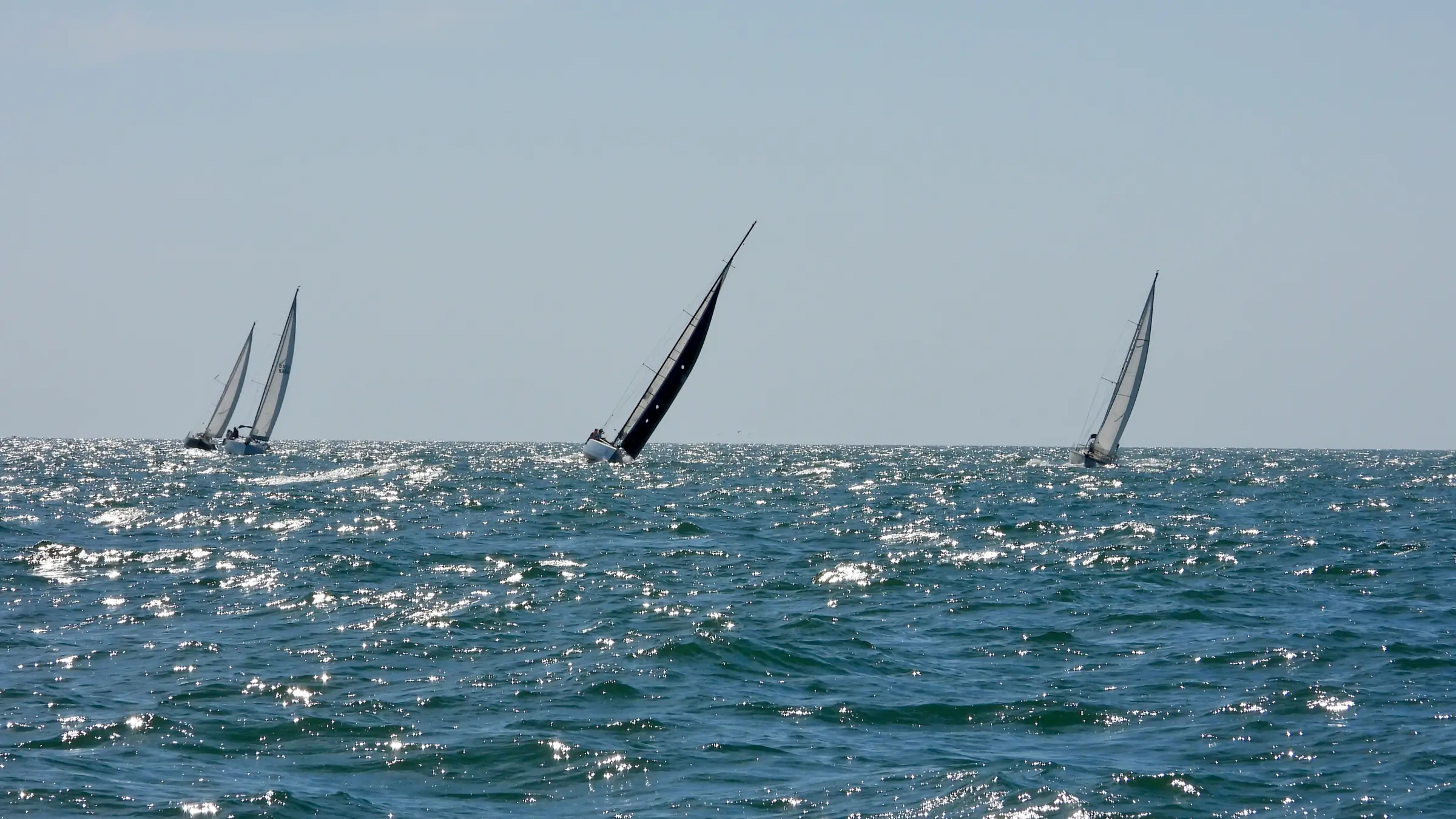
The winter sailor’s year runs backwards here. Hurricane season closes on November 30, the first cold fronts have already dried the air, and from then until Easter the whole state is in its sailing season: the trade winds settle in over the Keys, the one-design midwinters arrive from the north, and the clubs that went quiet in the August heat race every weekend. If you are reading this from somewhere with a frozen lake, the questions are practical ones. What is the weather actually like, and where. What a cold front does to a week. Whether you will swim. Where the racing is. And how to sail for three months in a place where you do not own a boat. Here is the season, region by region, with the numbers from the National Weather Service and the rest from the clubs, schools and charter operators themselves.
What winter is here
Florida has a wet season and a dry season rather than four of anything, and the dry season is the sailing season. The National Weather Service office in Melbourne puts its median start on October 15 for east central Florida, the day the first real cold front drops the air behind it, and describes the winter as fronts that keep pushing through December, January and February, each sometimes preceded by a line of showers, with far less rain than summer. In Key West the office counts December through April as the dry season, with just under a quarter of the year’s rain, most of it falling ahead of a front.
What that means on the water is a weekly rhythm rather than a forecast. Two or three days of warm southerly or southeasterly wind build ahead of a front; the front comes through, often with a short line of showers; the wind clocks through west to north and blows hard for a day, sometimes two, under a clear sky with the temperature twenty degrees lower; then it backs around to the east and the postcard returns. A sailor who plans around the fronts rather than against them gets the best wind of the year. The when to sail guide covers the whole calendar; this page is about the months the snowbirds are here.
Winter is also the windy half of the year. The Key West airport’s long-run average (1970 to 2016, in the Key West office’s wind tables) is 11.2 mph in January and 11.5 in March against 8.9 in July. The summer sea breeze is a reliable afternoon thing; winter wind is all day.
Region by region
The state is 500 miles tall, and the sailing winter in Pensacola is a different animal from the one in Key West. The temperatures below are NOAA’s 1991 to 2020 January normals for the airport nearest each water, and the water temperatures are the January monthly means in NOAA’s coastal water temperature tables, both read in October 2026.
The Keys are the nearest thing in the country to winter in the trade-wind belt. Key West’s January normal is 76 by day and 66 at night, the winter average over December to February 77 and 67, the water about 72 at the Key West station and 71 in Florida Bay off Marathon. The Key West office notes that the fronts are “modified by the warm water as they move in from the north” and that there is no record of frost in Key West (the airport’s normals have no night below 40 at all); ice has been reported in the Upper Keys. The practical effect is that a front here is a day of fresh northerly and a cool evening rather than a cold spell, and that the easterly trades return faster than anywhere else in the state. The racing comes to meet the winter: the Snipe Midwinters and A-Class catamaran Midwinters sail from the Upper Keys Sailing Club in Key Largo, the Key West Community Sailing Center runs free adult classes on Garrison Bight from October to April and a Moonlight Regatta each full moon through the same months, and the schooners that summer in New England come south: Hindu from Provincetown and Appledore II from Camden both sail their winter seasons from the Historic Seaport (Schooner Hindu, Key West Schooners). The cruising fleet winters here too, and Boot Key Harbor in Marathon is the mooring field everyone has heard of; the living-aboard guide covers it and the anchoring rules.
Miami and the Southeast have Biscayne Bay, which is the reason the Olympic classes winter here. Miami’s January normal is 76 and 61, Fort Lauderdale’s 76 and 61, and the water at Virginia Key is about 72, outside the bay and in. The bay is flat, shallow and protected from the ocean swell, which is why the Olympic and international one-design classes spend their winters on it: the Orange Bowl between Christmas and New Year, the Bacardi Winter Series in January and February building to the 100th Bacardi Cup in March, Miami Sailing Week’s youth regatta, the 470 Midwinters and the Don Q Snipe Regatta, with the Biscayne Bay Yacht Racing Association’s monthly series running October to June underneath all of it. The ocean outside is the Gulf Stream a few miles off, and the one rule a visiting sailor needs is that a north wind against it builds a short, steep, ugly sea; the day after a front is a bay day, not an ocean day. Farther up the coast, Gulfstream Sailing Club races an Ocean Winter Series off Port Everglades from November to April, Fort Pierce Yacht Club runs a named offshore race day a month from January to May, and Palm Beach Sailing Club races on Sundays all year.
Tampa Bay and the Gulf coast are where most of the winter racing is, and where the winter is a real season rather than a warm one. Tampa’s January normal is 71 and 53, Fort Myers 75 and 54, and the water is cooler than the Atlantic side: about 65 in Tampa Bay at St. Petersburg, 62 off Clearwater Beach, 67 at Naples and Fort Myers. The Tampa airport’s normals give the winter seven nights below 40 and one at freezing; on those mornings the Gulf is grey and lumpy for a day; then the sea breeze pattern reasserts itself and the bays go glassy and warm by lunch. The calendar is the attraction. Of the 96 regattas and series events on this site’s calendar between December 2026 and March 2027 as of mid-October 2026, 49 are on this coast: the Helly Hansen Sailing World Regatta Series, the ILCA Midwinters East and the Winter Lightning Championship at St. Petersburg Yacht Club; the Gasparilla Regatta off Ballast Point in January; the J/70 Winter Series, the Thistle Midwinters and a Full Moon Series from November to March at Davis Island; Clearwater Yacht Club’s Winter Howler on the Gulf; the Snowbird Regatta in January and the E Scow Midwinters in March at the Sarasota Sailing Squadron; Venice Sailing Squadron’s Saturday races from October to May; Platinum Point’s Monday series on Charlotte Harbor from October to March. At Boca Ciega Yacht Club in Gulfport the Sunfish race on Saturdays in winter, in the club’s own words, “when the snowbirds are down”.
The Northeast and First Coast have an actual winter. Jacksonville’s January normal is 66 and 43, the water at Mayport about 58 and at St. Augustine 59, and the airport’s normals put a dozen nights at or below freezing between December and February and thirty-five below 40. The club calendars thin after Thanksgiving and restart with St. Augustine Yacht Club’s inshore PHRF season in February on the Tolomato, open to any skipper. The First Coast’s winter sailors are mostly the ones passing through: the Intracoastal Waterway carries the snowbird cruising fleet south in November and north again in April, and St. Augustine’s mooring field, the Schooner Freedom’s seasonal sails and the Nights of Lights trips on Fury are built around that traffic. A fleece and a foul-weather jacket are not optional here.
The Panhandle is the cool corner. Pensacola’s January normal is 63 and 44, the water about 57, ten winter nights at or below freezing in the normals, and a front from the northwest arrives unmodified by any warm water. The fleets sail anyway: Pensacola Yacht Club’s bay championship runs twelve races from January to October, Apalachee Bay Yacht Club opens the year with the Will Glenn Frostbite Regatta on New Year’s Day, and Pensacola Sailing Academy teaches its liveaboard cruising courses through the winter with the Gulf pass open when a course earns it. It is the right place for a northerner who wants Florida water without Florida crowds, and the wrong place for one who wants to swim in January.
Inland, the lakes are the midwinter circuit for the trailer classes: the Wayfarer Midwinters in January and the George Washington Birthday Regatta for Flying Scots in February at Lake Eustis, the Mount Dora Regatta in March, and on the Banana River the Melges Watersports Center’s winter series for the MC Scow, Melges 15 and Melges 19 from November to April, with Melges 15s available to charter for the series, which is the easiest way anyone has yet devised to race a season in Florida with nothing on the trailer.
Air and water, in January
The 1991 to 2020 January normals (daytime high and overnight low) and the January water means, north to south, so the choice of coast is a choice of numbers:
- Pensacola: 63 and 44 in the air; 57 in the bay.
- Jacksonville: 66 and 43; 58 at Mayport, 59 at St. Augustine.
- Daytona Beach: 69 and 49; 67 at Port Canaveral’s Trident Pier.
- Tampa: 71 and 53; 65 in Tampa Bay at St. Petersburg, 62 off Clearwater Beach.
- Fort Myers: 75 and 54; 67 at Fort Myers and Naples.
- West Palm Beach: 75 and 58; 75 at the Lake Worth pier, the warmest water on the mainland, courtesy of the Gulf Stream.
- Miami: 76 and 61; 72 at Virginia Key.
- Key West: 76 and 66; 72 to 73 at the Key West station, 71 in Florida Bay.
February runs a degree or two warmer than January everywhere, and March is spring: 80 by day in Miami, 78 in Tampa, 74 in Jacksonville. The Melbourne office’s own description is that late February through March “most closely resembles typical spring weather in the higher latitudes”, large swings included, and that April is often the driest month of the year.
Sailing a season without owning a boat here
This is the question the page exists for, and the state has six answers. The good news is that most of them cost less than storing a boat at home for the winter.
- Join a community sailing center or an open club with a fleet. The public centers and the member-owned clubs that keep club boats are the snowbird’s best-kept secret, because membership is open and the boats are at the dock. The St. Petersburg Sailing Center at Demens Landing lets members rent boats and sail Tampa Bay without owning one; the Key West Community Sailing Center’s members sail its small-boat fleet on Garrison Bight and its adult classes are free; Halifax Sailing Association in Daytona Beach keeps nine boats from Sunfish to a Catalina 25 on its dock for members to take out first come, first served, with no rental fee on top of dues; Coconut Grove Sailing Club is an open-membership club with a fleet of club boats and a mooring field on Biscayne Bay; the Sarasota Sailing Squadron keeps certified instructors and a fleet to learn on; the Sailing Club of Winter Park sails a twelve-boat dinghy fleet from Lake Baldwin Park, with open membership; Englewood Sailing Association runs member sailing on its fleet and a four-day adult course in February, March and November. Ask each one whether it sells a seasonal or short-term membership; the pages describe the fleet and the open door, and the term is a question for the office. The clubs directory marks every entry with a learn-to-sail program, and the public ones say “open to the public” on their pages.
- Buy days, not a boat. Two listed operators sell sailing by the block rather than by the charter: Island Sailing in Naples puts a skipper through a four-hour captained checkout and then sells days in blocks of five or ten, to be used inside eighteen months, with the skipper in charge of the boat on each of them; Key Lime Sailing Club & Cottages in Key Largo rents a cottage on Florida Bay with a Catalina 22 at the dock, free to use for a qualified sailor with recent time on the water, and American Sailing Academy teaches ASA courses on the same site for the ones who are not yet. The charters directory has a filter for the membership model.
- Charter for a week, or several. Ten listed operators rent a keelboat or cruising catamaran you skipper yourself as of October 2026, from Marathon and Key Largo to Fort Lauderdale, Naples, Cape Coral, Sarasota, Panama City and Niceville; the bareboat page lists them and the requirements guide says what each asks for, which in Florida is usually a résumé or a checkout sail rather than a certificate. Winter is their high season, so book ahead. One operator, Florida Sailboat Charter on Charlotte Harbor, is a winter business outright, closed for the summer until November.
- Crew. Florida’s club racing runs on visiting crew in winter, and several clubs say so on their own pages. Venice Sailing Squadron holds its Saturday skippers’ meeting at Higel Marine Park at ten, where crew looking for a ride are matched with boats; Boca Ciega Yacht Club’s Sunday PHRF series welcomes visitors to turn up and crew; Davis Island Yacht Club’s Thursday Night Races are open to anyone regardless of club affiliation; St. Augustine Yacht Club’s races are open to any skipper; Lake Monroe Sailing Association keeps a crew finder; Amelia Island Sailing Club says “no boat is necessary to start your journey”; Platinum Point lets non-members arrange a start in its Monday series through the office. The one-design midwinters above are the other door: a Snipe, Lightning or J/70 skipper who has trailed a boat 1,200 miles south is often one crew short, and the skippers’ meeting is where to say so. Bring closed-toe shoes and a willingness to duck the boom.
- Learn, aboard. A liveaboard course is the fastest way to turn a winter week into a certificate, and the Florida schools built their calendars around northern visitors: Blue Water Sailing School in Fort Lauderdale runs week-long liveaboard courses to the Keys and the Bahamas; Florida Sailing & Cruising School in Cape Coral teaches two to ten days aboard on Pine Island Sound, on the fleet it shares with Southwest Florida Yachts, so the graduate can charter the boat she learned on; Pensacola Sailing Academy’s combined 103 and 104 is six days and five nights on a Beneteau 393 with meals included; Offshore Sailing School teaches the NauticEd pathway from Sarasota and St. Petersburg; Coconut Grove Sailing School runs a six-day liveaboard “Sail-cation” on Biscayne Bay; Sail Away Key West runs its catamaran courses as multi-day training cruises from Stock Island. The ASA schools page and the schools directory have the rest.
- Bring the boat. Trailer sailers come down the interstate and launch at the public ramps the FWC lists county by county. Cruisers come down the Intracoastal in November and find the mooring fields at Marathon, Vero Beach and St. Augustine “often full in season”, as the living-aboard guide puts it, so reserve. If you belong to a yacht club at home, read the reciprocity guide before you leave; a club card and a letter of introduction open dining rooms and, at many clubs, a first night at the dock the whole way down the coast.
One document question for the boat you rent or bring: Florida requires its Boating Safety Education Identification Card of anyone born on or after January 1, 1988 who operates a motorboat of ten horsepower or more, which includes every cruising boat’s auxiliary. The FWC accepts a NASBLA-approved boater safety card from another state with photo ID, exempts holders of a Coast Guard master’s licence, and lets a visitor without either rent a boat on a temporary certificate. A beach cat with no motor sits outside the rule; the Hobie guide covers the stands.
What to bring
- Layers, and a real jacket. The temperature table above is the daytime high; the morning after a front in Tampa or Jacksonville is in the 40s, the wind is in the north at twenty, and a Gulf coast dinghy sailor in January is in 62-degree water. Foul-weather jacket, fleece, a hat that stays on. The Keys in a trade wind are shorts weather; the Keys the day after a front are not.
- The wetsuit question. South of Fort Myers and Palm Beach, the water is in the 70s all winter and nobody wears one. From Tampa Bay north, dinghy and beach-cat sailors wear a shorty or a top in January, and Panhandle frostbiters dress for 57-degree water.
- Sun, still. The sun is lower but the days are clear, the glare off a flat bay is the same, and the long-sleeve shirt, polarised glasses and closed-toe deck shoes you bring for summer are the winter kit as well.
- Paper. Your home club’s membership card and a letter of introduction from its office (the reciprocity guide says which clubs want which); a boater-education card from your state if you were born in 1988 or later; your sailing résumé, written down, because a charter dock will read it before it reads a certificate.
- A VHF and the forecast. Every region hub on this site carries the National Weather Service point forecast for its launch points and any active marine alert; the small-craft advisory that follows a front is the one to watch for, and a front’s arrival is forecast days out, which is enough to move a sail or a passage.
When to come
Any time between the end of hurricane season and Easter is the season, and the differences are small. December and January have the strongest fronts and the most one-design racing; February is the month the charter docks fill; March is the warmest of the three and the month the trailer classes finish their midwinters and head home. If the trip is a week, make it coincide with a regatta you want to see, even from the committee boat: the events calendar carries the dated ones, each with its own page, and a club that is hosting a midwinters is a club that will put you to work.
Last reviewed October 2026.